
The Bigger Risk Is Playing It Safe
For most of his life, my brother-in-law Eiman did everything right.
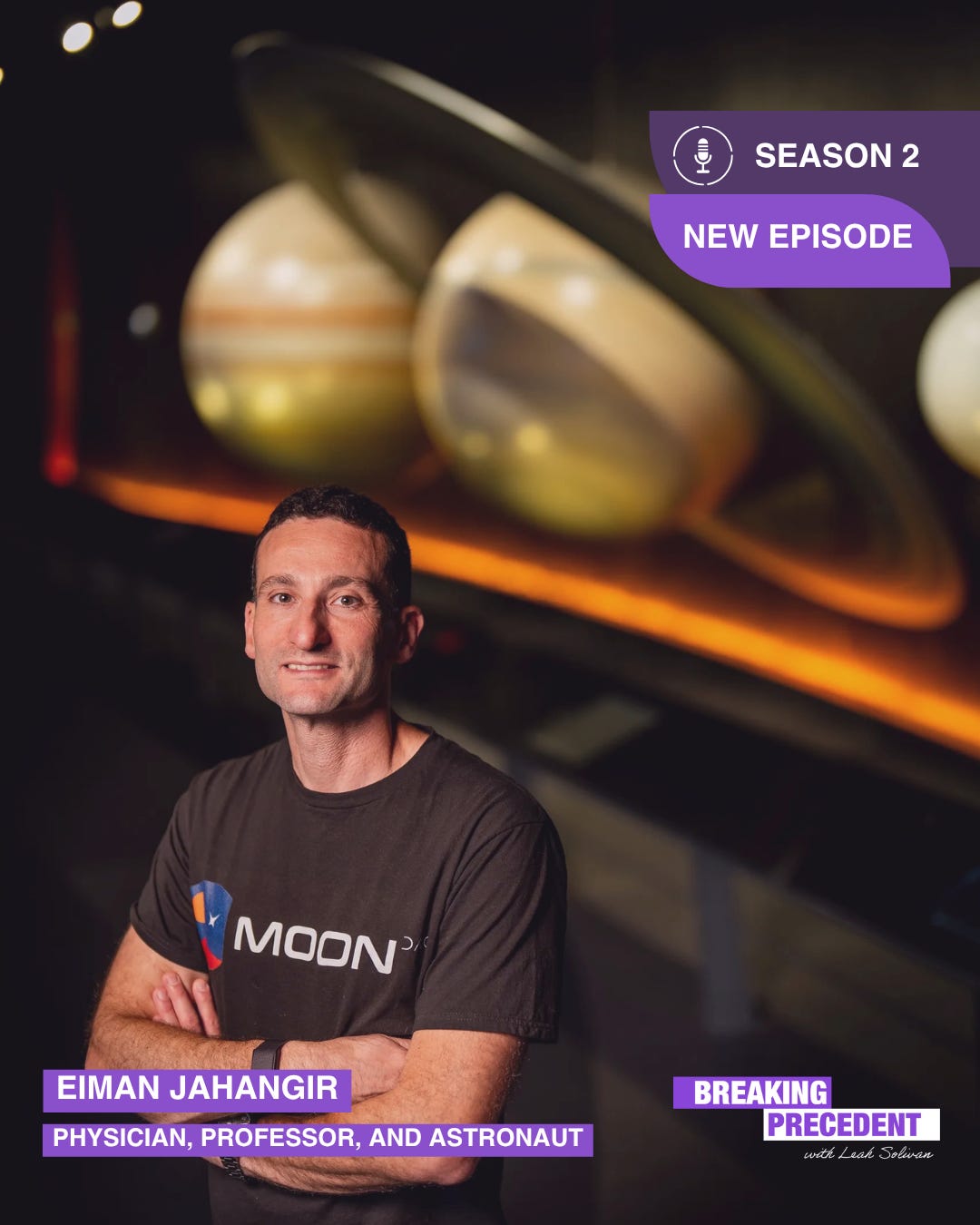
He became a doctor, then a cardiologist, then a professor at Vanderbilt. He built the kind of life immigrant families dream about when they come to America: stability, respect, security, and upward mobility. It was the kind of life that signals success not only to the outside world, but to the generations that came before you and sacrificed so much to make that success possible.
And yet, underneath all of it, he carried a dream that made very little sense inside the framework of the life he had built.
He wanted to go to space.
Not metaphorically. Literally.
When people hear Eiman’s story now, they tend to focus on the outcome. The astronaut title. The Blue Origin flight. The improbability of it all. But what interests me most is not the launch itself. It is the tension that existed long before any rocket ever left the ground.
Because I think many people eventually reach a moment when the life they've built starts to feel strangely incomplete.
Not bad. Not unsuccessful. Not broken.
Just misaligned.
That is a difficult feeling to admit, especially when your life already looks successful from the outside. There is a particular kind of guilt that can accompany ambition after achievement. Once you have stability, once you have built a respected life, it can feel almost irresponsible to want something more. Not more money or more status, but something harder to explain. Something tied to meaning, curiosity, aliveness, or identity.
For children of immigrants, especially, that tension can feel deeply complicated. Stability is not abstract. Stability is sacrifice. Stability is what your parents crossed oceans, survived uncertainty, and worked impossible hours to create. You do not casually walk away from that.
And Eiman did not walk away from it.
That is what makes his story so compelling to me.
He did not blow up his life. He did not abandon responsibility. He did not suddenly become reckless. He stayed deeply committed to his family, his patients, and the life he had built.
What changed was not the dream. What changed was his understanding of how the dream could happen.
For years, NASA represented the only legitimate path to space. It was the official route, the respected route, the approved route. But after enough rejection, Eiman began to realize something important: the vision itself still felt true, even if the original path no longer did.
During a recent conversation on my podcast, he said something that perfectly captured that shift:
“You have to be firm on the vision, but flexible on the details.”
I think a lot of people get trapped because they confuse the path with the purpose. They become so attached to one version of success that they abandon the deeper thing they actually wanted in the first place.
At a certain point, many of us stop asking what we truly want and start managing what seems reasonable, responsible, efficient, approved, or legible to the people around us. We become loyal to the version of ourselves that learned how to succeed.
And slowly, without fully realizing it, we begin editing out the parts that still feel alive.
The truth is that success can become its own form of inertia. The career works. The structure works. The identity works. Until one day, something inside you realizes that functioning and alignment are not always the same thing.
That does not mean your life is wrong. It does not mean you are ungrateful. It does not mean you need to destroy everything you built.
But it may mean there is still a part of you waiting to be acknowledged.
That is why I am excited for Eiman’s upcoming book, A Heart for Space.
Yes, it is a story about space, ambition, and impossible dreams. But underneath all of that, it is really about something much more universal: what happens when you stop treating your deepest longing like something you are supposed to outgrow.
It is about what it means to remain loyal to a vision, even when the path toward it changes completely.
So I will leave you with this:
What dream have you quietly convinced yourself is no longer practical simply because your life already looks successful?
And what if the bigger risk is not failure?
What if the bigger risk is never finding out who you might have become?


