
What If the Best Practices Aren’t Actually the Best?
When TaskRabbit was being acquired, we had options.
There were multiple potential buyers, multiple visions for the company's future, and multiple paths available to us. From the outside, some of those paths appeared easier than the one we ultimately chose.
I remember feeling frustrated at times during the IKEA process. Decisions seemed to take longer than I expected. Conversations unfolded more deliberately. There was a level of scrutiny and reflection that felt fundamentally different from the pace of the startup world I had spent years navigating.
At the time, I interpreted much of that as bureaucracy.
In startups, speed is a virtue. Decisiveness is a virtue. We celebrate the ability to move quickly, iterate quickly, and close quickly. When something takes longer than expected, we often assume that inefficiency is to blame.
Looking back, I see something different.
What I was experiencing was not bureaucracy. I was experiencing a company operating from a different set of incentives.
IKEA was not optimizing for the next quarter. It was not evaluating every decision through the lens of immediate financial return. There was a longer horizon embedded in the way decisions were made. There was a sense of stewardship that felt different from many of the institutions I had encountered throughout my career.
I did not have the language for it then.
After reading Eric Ries’s upcoming book, Incorruptible, and speaking with him recently on Breaking Precedent, I think I finally do.
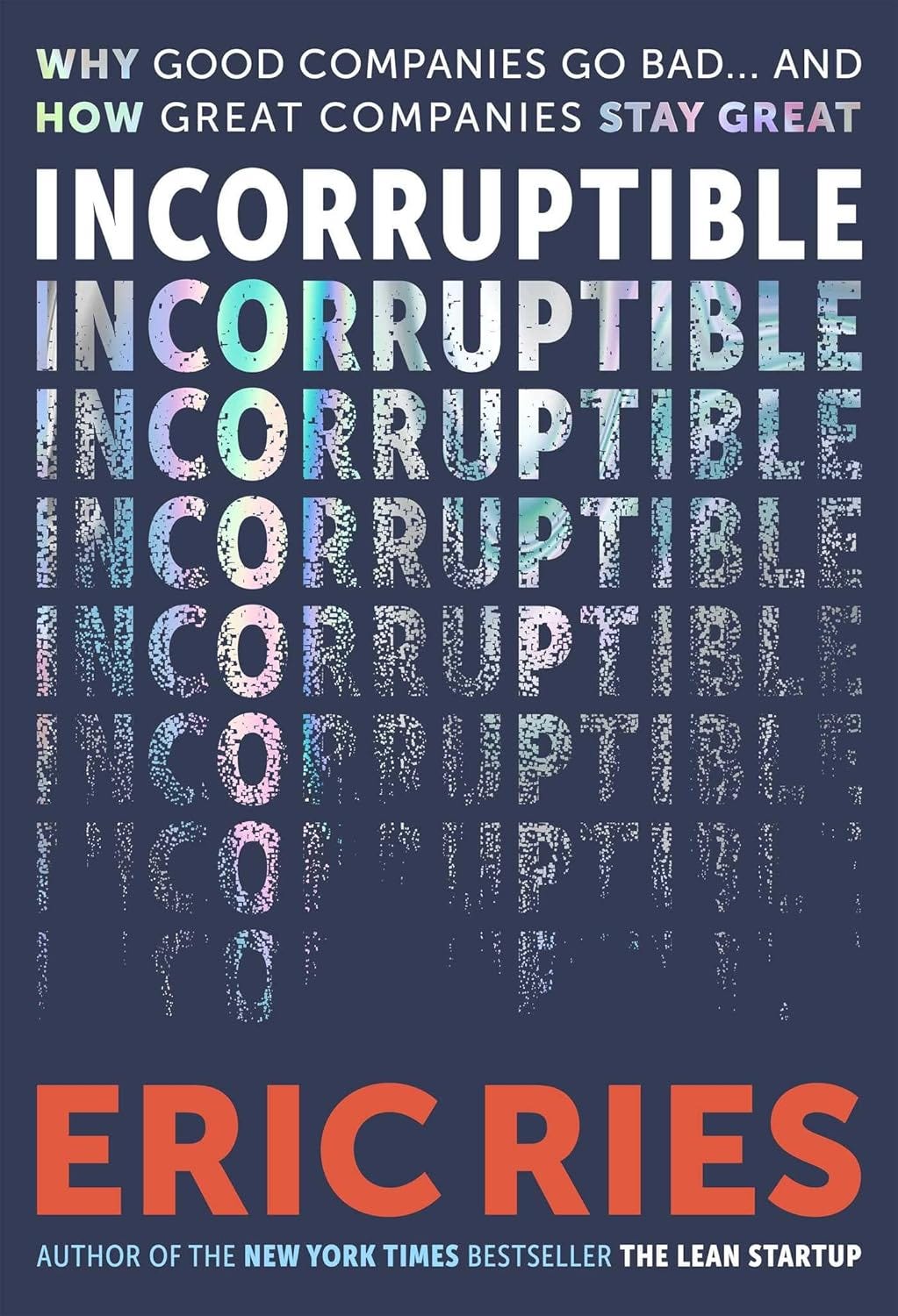
Most people know Eric as the creator of the Lean Startup movement. His work fundamentally changed how founders think about building companies. He challenged one of the most deeply held assumptions in entrepreneurship: that progress comes from building more things.
Instead, he argued that progress comes from learning.
That idea seems obvious today, but when Eric first introduced it, it was radical. Founders were rewarded for shipping more features, writing more code, and executing larger plans. Eric’s insight was that none of those things mattered if you were learning the wrong lessons.
What struck me during our conversation, however, was not what Eric taught founders twenty years ago. It was the question he is asking now.
His new book examines an assumption that sits at the center of modern business. It is an assumption so common that most of us rarely stop to question it.
We assume that best practices are best because they work.
It sounds self-evident.
If a practice has survived for decades, if it is taught in business schools, repeated by investors, adopted by large companies, and reinforced by consultants, surely there must be a good reason for it.
But what if there isn’t?
What if some practices survive not because they are the most effective, but because they are the most repeated?
The longer I sat with that question, the more I realized how often we confuse familiarity with truth.
This is not just a business problem. It is a human problem.
We do it in our careers. We do it in leadership. We do it in parenting. We do it in relationships. We inherit a set of assumptions about how things are supposed to work, and then we stop examining them. Over time, those assumptions become invisible.
They stop feeling like choices, and they start feeling like reality.
One of the reasons I found Eric’s argument so compelling is that it mirrors something I have seen repeatedly throughout my own entrepreneurial journey. Some of the most transformative decisions I made as a founder required me to reject conventional wisdom.
Not because I wanted to be contrarian.
Not because I believed I was smarter than everyone else.
But the conventional approach was designed for circumstances that did not match the reality I was facing.
As founders, we are constantly told to learn from precedent. That advice is often valuable. The problem is that precedent can easily become a substitute for thinking.
At some point, every founder encounters a moment when the established playbook no longer applies. The market changes. Technology changes. Consumer behavior changes. The assumptions underlying the old model no longer match reality.
When that happens, following precedent can actually become the riskier choice.
That is why Eric’s research fascinated me.
Throughout Incorruptible, he highlights companies that consistently ignore conventional governance wisdom and yet continue to outperform. Companies like Costco, IKEA, Patagonia, and Novo Nordisk have all built enduring institutions by operating differently than many experts would recommend.
The traditional explanation is that these companies are exceptions.
They are unusual. They are unique. They are interesting stories, but ultimately not representative of how the world really works.
That explanation has always bothered me.
Exceptions are comfortable because they allow us to preserve our existing worldview. We can admire them without learning from them. We can celebrate their success without questioning our assumptions.
Eric proposes a different interpretation. He argues that these companies are not exceptions. They are clues. That distinction is profound.
A clue points toward something hidden. It suggests there is a deeper truth beneath the surface that we have not yet fully understood. It invites investigation.
When I think about IKEA through that lens, many things begin to make more sense.
What if the patience I experienced during the acquisition process was not a weakness?
What if it was a reflection of a company optimized for longevity instead of speed?
What if some of the friction I felt was actually the result of a system designed to protect something more valuable than efficiency?
Those questions become even more interesting when you zoom out beyond any individual company.
What if many of our modern business practices are optimizing for the wrong thing entirely?
What if transaction volume has become more important than trust?
What if short-term activity has become more valuable than long-term stewardship?
What if we have spent decades refining systems that reward motion while quietly eroding durability?
These are not abstract questions anymore.
They shape how companies are built. They shape how leaders behave. They shape how capital flows. They shape what gets rewarded and what gets ignored.
Most importantly, they shape the precedents that future generations inherit.
That is why this conversation feels so relevant right now.
The most dangerous precedents are rarely the visible rules. They are the assumptions hiding underneath them. They are the beliefs that have become so familiar that nobody thinks to question them anymore.
Those assumptions often survive long after the conditions that created them have disappeared.
And because they are invisible, they are rarely challenged.
The people who break precedent are not usually the people looking for rules to rebel against. More often, they are the people who notice a contradiction. They see a gap between what everyone says works and what actually works. They become curious enough to investigate it and courageous enough to act on what they discover.
That is exactly what Eric did with The Lean Startup, and it is what he is doing now with Incorruptible.
It is a reminder that some of the most important breakthroughs begin with a deceptively simple question:
What if the thing everyone assumes is best is simply the thing everyone copied?
So I will leave you with this:
What best practice in your own life have you accepted without questioning?
And if you looked closely, would you find evidence that it is actually the best?
Or would you find a clue pointing somewhere else?


