
The Most Important Career Decision Might Be the One You Get Wrong
Gary Swart could have been one of the first employees at Netflix.
Instead, he said no.
Before Netflix was Netflix, Gary was working at Pure Software with Reed Hastings and Marc Randolph. When Pure was acquired by Rational Software, Reed and Marc started thinking about what they wanted to build next.
Their idea was to put DVDs in envelopes and mail them to people.
Gary was not convinced.
Why wouldn’t people just go to Blockbuster? A lot of people didn’t even have a DVD player. The idea sounded so questionable that Gary joked to Marc, “Why don’t you just mail me an offer in a red envelope?”
The red envelope never came.
Gary stayed at Rational.
Looking at that decision now, knowing what Netflix became, it is easy to think: How could you possibly say no?
The problem with hindsight is that it makes uncertainty disappear.
At the time, Netflix was not Netflix. It was an idea.
Meanwhile, Gary had three kids. Rational was offering him a bigger role, a bigger title, meaningful financial incentives to stay, and a clear path forward.
As Gary told me when we sat down, “At the time, I was optimizing for different things.”
I keep coming back to that line.
We spend too much time asking whether we made the right decision and not enough time asking what we were optimizing for when we made it.
The fork only looks obvious in reverse
Career stories become incredibly neat when we tell them backward.
There was the safe choice and the risky choice. The startup and the corporate job. The opportunity taken and the opportunity missed.
Once we know how everything turned out, we start rewriting the decision itself. Of course he should have joined Netflix. Of course the startup was the better bet.
Except none of that was obvious at the time.
Gary was not choosing between Rational and the Netflix we know today. He was choosing between a real opportunity with financial security and an unproven idea about mailing DVDs.
That distinction matters.
Founders live with this constantly. When I was building TaskRabbit, there was no established playbook for what we were creating. We were making decisions about marketplaces, consumer behavior, technology, hiring, fundraising, and the future of work while simultaneously trying to build the company.
You make the best decision you can with what you know. Then you learn something new.
The question is not whether you could have predicted the ending.
It is whether you understood what you were optimizing for when you made the choice.
Early in Gary’s career, success looked pretty straightforward.
He had built a manufacturing business. He was making money. He bought a house. He bought a red BMW. Many of his friends were not making much money yet, and from where he was sitting, this looked like success.
But eventually he started asking a different question.
What am I actually building?
His manufacturing business was directly tied to his own inputs. More work meant more contracts, more parts, and more money. But there was little leverage.
At the same time, he was watching people in tech who were genuinely excited about what they were building.
His definition of success began to change.
That evolution continued throughout his career.
Today, Gary has a framework for evaluating opportunities that includes the people he will work with, the impact he can have, how much he will learn and grow, financial reward, whether he is excited about the work, and balance.
I love this framework because the answer changes depending on where you are in life.
The weighting changes.
At one stage in your life, financial security may matter enormously. At another, you may optimize for learning. Later, impact or the people around you might become the thing you are unwilling to compromise.
Gary also has what he calls the Sunday night test.
How do you feel on Sunday night about going to work on Monday?
It is a remarkably simple question.
And sometimes simple questions tell you more than titles, compensation packages, or carefully constructed career plans.
The lesson is not “always take the startup job”
It would be easy to turn Gary’s Netflix story into a lesson about risk.
Take the crazy opportunity. Join the startup. Choose uncertainty.
But I do not think that is the interesting lesson.
Looking back, one thing Gary says he would have weighted differently was the people.
He already knew Reed Hastings and Marc Randolph. He knew how smart they were. He knew what they were capable of.
Today, Gary tells people that the people you choose to work with should be one of the most important factors in a career decision. He has even said he would take a lesser title to work with certain people.
Because you cannot know which company will become the next Netflix.
But you can pay attention to the people.
You can ask whether you will learn from them.
You can ask whether you will be pushed.
You can ask whether you believe they are the kind of people who will find a way forward when the original plan stops working.
Those are signals you can actually evaluate in the moment.
Sometimes you have to get in the river
Another phrase Gary used in our conversation stuck with me: “Get in the river.”
His point was that if you put yourself in an environment where things are moving quickly and then do great work, opportunities start appearing that you could never have planned for.
That was Gary’s experience at Pure Software.
He arrived without the traditional technology background. He was thrown into an environment where he had to learn quickly. Then, as the company grew, he kept getting tapped for jobs he did not think he was ready for.
Gary calls them “battlefield promotions.”
The company had problems that needed solving, and Gary kept stepping forward to solve them.
His advice is to find an environment that is growing quickly because growth creates problems, and problems create opportunities for people who are willing to step up.
That is a very different way of thinking about career planning.
Instead of trying to predict your exact destination, choose the river carefully.
Then get in.
Gary did not wake up one morning with a perfect framework for making career decisions.
He built it piece by piece.
Some of it came from successes.
A lot of it came from mistakes.
He described another career move where he left IBM because he wanted to get back into the startup world. Looking back, he realized he had made a classic mistake.
He was running from something instead of running toward something.
Knowing what you want to leave behind isn’t the same as knowing what you want to build next, and that shaped the choice he made from there.
This is what I find so compelling about Gary’s story.
The goal is not to eliminate bad decisions. You can’t.
The goal is to become a better decision maker.
Every fork gives you more information about yourself. What matters to you? What kind of people bring out your best work? What tradeoffs are you willing to make? What kind of problems do you actually want to spend your time solving?
Your answers at 25 may not be your answers at 35 or 55.
That is not inconsistency.
That is experience.
So maybe we should stop calling them wrong decisions
I think we are too quick to split our careers into the decisions we got right and the decisions we got wrong.
Careers are much messier than that.
Gary did not join Netflix.
He went on to lead oDesk, helping build a marketplace that challenged one of the most fundamental assumptions about work: that talent and opportunity had to exist in the same physical place.
He became an investor and advisor to founders.
Would he make the Netflix decision differently today?
Yes.
But he could not have known what Netflix would become.
What he could do—and what he has done—is get clearer about what matters when the next decision appears.
So instead of asking yourself, “What if I choose wrong?” try asking:
What am I optimizing for?
Who am I choosing to surround myself with?
Where am I going to learn the most?
What tradeoffs am I willing to make?
And maybe most importantly:
If this does not turn out the way I expect, what will I have gained anyway?
You cannot make career decisions with hindsight.
But you can build better filters for the next one.
And sometimes the decision you think you got wrong is the one that teaches you what to look for when the next fork appears.
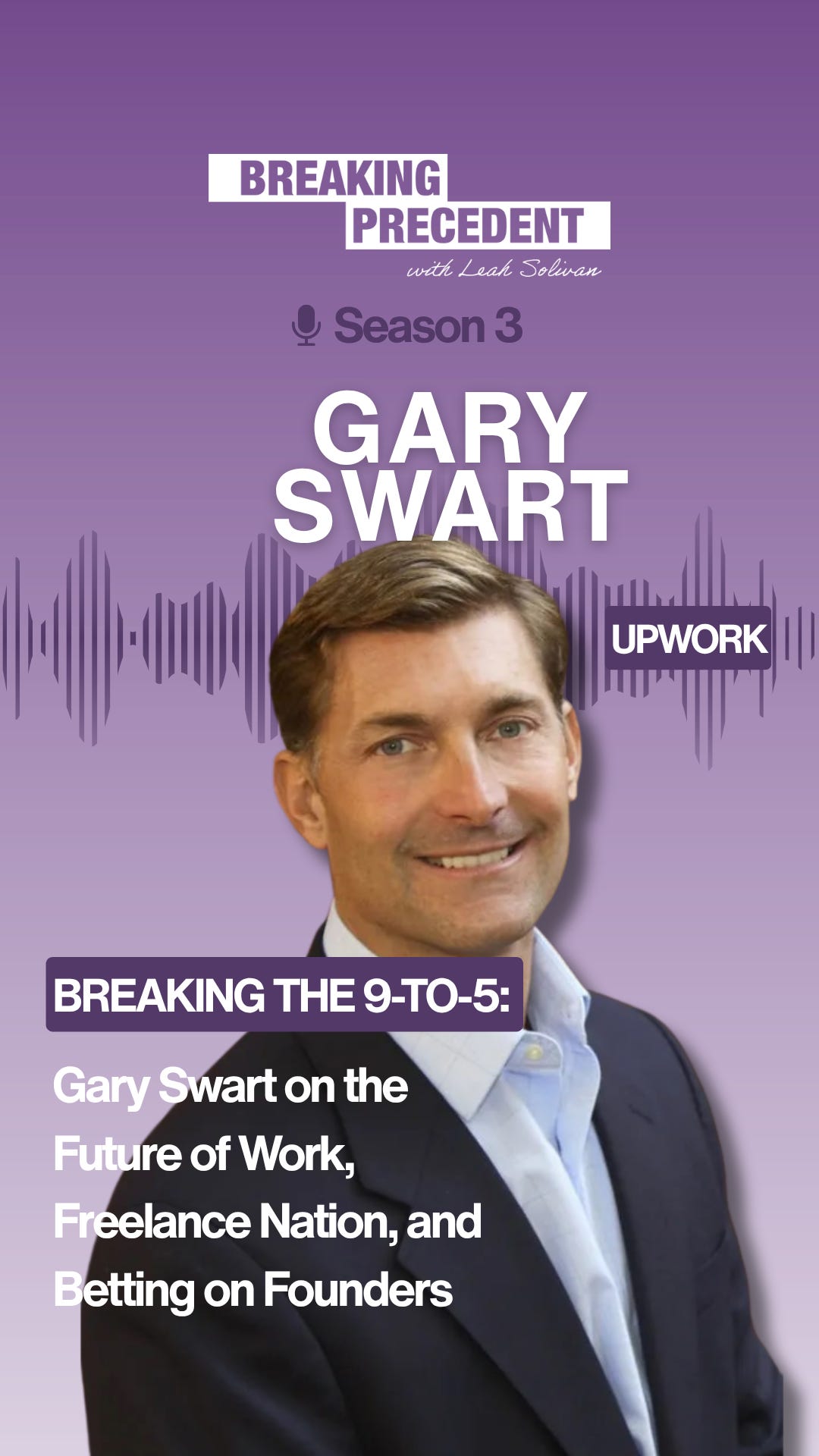
This week pairs with our latest episode of Breaking Precedent, where I sit down with Gary Swart to unpack the career decisions that shaped his path, from passing on the chance to join Netflix, to leading oDesk, to developing a clearer framework for what really matters when choosing what comes next. We talk about hindsight, the people you choose to work with, and why the decisions that look wrong in retrospect can sometimes teach you the most.
Thank you to our Precedent Breaking Partners, Justworks, Taskrabbit, and SquaredAway, for supporting this season’s conversations!


